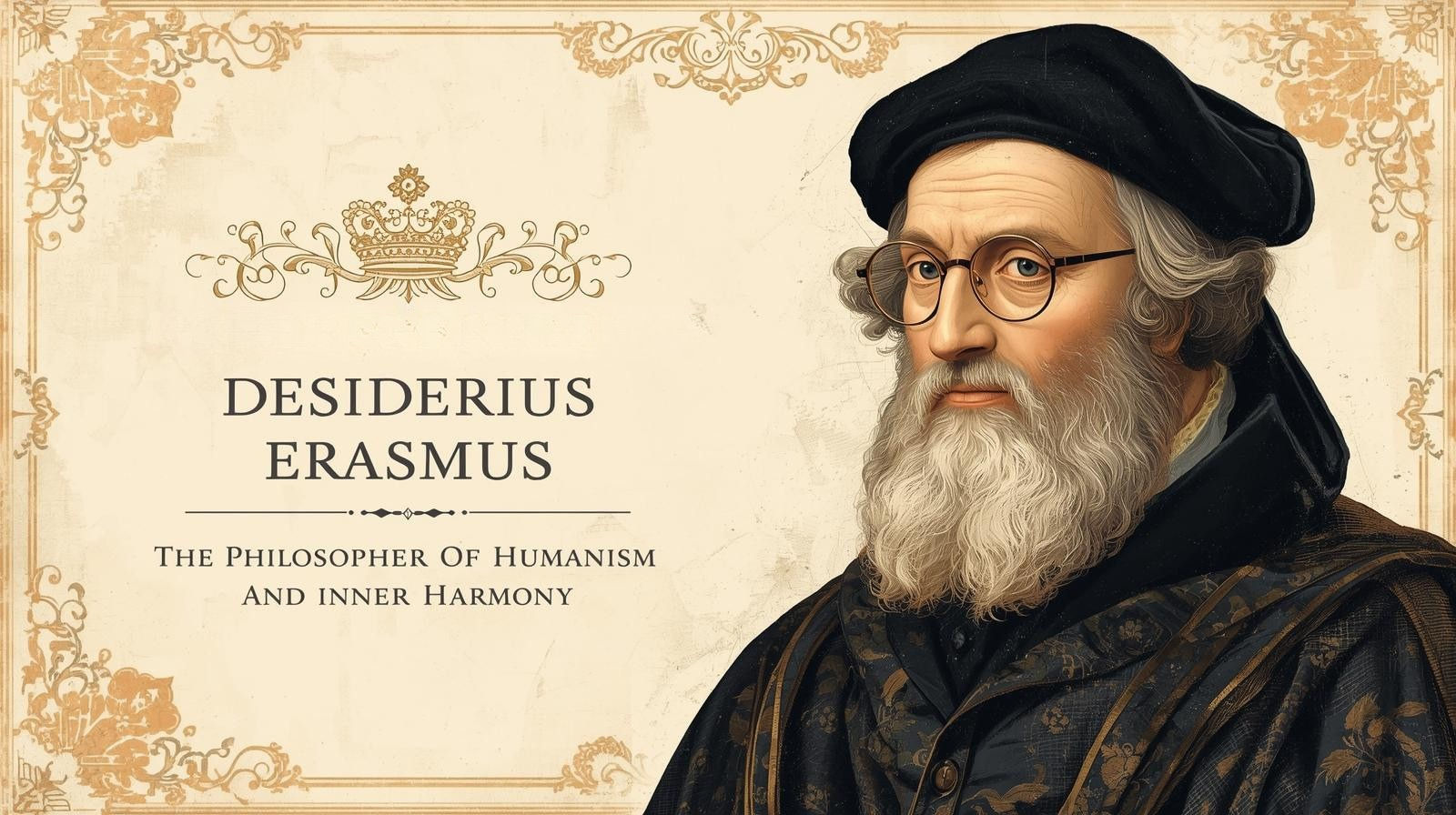
Desiderius Erasmus (1466–1536): The Philosopher of Humanism and the Awakening of Compassionate Consciousness
Desiderius Erasmus of Rotterdam was one of the most profound voices of the Renaissance — a thinker who illuminated the union between knowledge and virtue, intellect and love. A Dutch philosopher, theologian, and writer, Erasmus embodied the golden spirit of humanism: the belief that humanity’s true strength lies not in authority or dogma, but in wisdom and compassion.
Born in Rotterdam in 1466, Erasmus faced early hardships as the illegitimate child of a priest, yet his love for learning became his liberation. Through relentless study and deep contemplation, he transformed adversity into understanding, choosing the path of education over power, and reflection over rigidity. His life became a living example of how knowledge can elevate the human soul toward freedom and inner peace.
At the heart of Erasmus’s philosophy was a devotion to reason infused with love. He saw knowledge not as a weapon of superiority but as a tool of enlightenment. He often wrote that “the highest form of wisdom is kindness,” echoing the eternal truth of the Heart Chakra (Anahata) — the energetic center where intellect meets compassion, and understanding transforms into unity.
In his timeless masterpiece In Praise of Folly, Erasmus employed wit and irony to reveal the absurdities of pride, greed, and hypocrisy within both the Church and society. But his critique was not born from rebellion — it emerged from deep love for humanity’s potential. He sought to heal, not harm; to awaken, not accuse. Through laughter and wisdom, he guided people to self-reflection and authenticity.
Erasmus believed that true religion was not found in rituals or fear, but in inner purity, tolerance, and simplicity. He envisioned a Christianity rooted in the teachings of Christ rather than the power of institutions — a faith that spoke directly to the heart. His emphasis on returning to the original scriptures through Greek and Latin studies became one of the pillars of Renaissance reform and education.
This call to direct experience of truth resonates with the awakening of the higher chakras — especially the Heart and Crown Chakras, where divine love and divine wisdom merge. Erasmus’s humanism was not limited to philosophy or theology; it was a spiritual path leading toward the realization that enlightenment is not separation from the world but conscious participation in it.He saw humanity as capable of infinite growth — morally, intellectually, and spiritually. Each individual, he believed, carries the divine spark, and through education, empathy, and humility, that spark can illuminate the world. This vision aligns beautifully with the 112 chakras of consciousness, representing humanity’s multidimensional journey toward integration and wholeness.
Throughout his life, Erasmus remained a bridge between worlds — between faith and freedom, East and West, intellect and mysticism. He influenced countless reformers, from Martin Luther to Thomas More, yet remained independent, choosing peace over polarization. His strength lay not in confrontation, but in clarity — a soft, radiant wisdom that continues to inspire seekers and scholars alike.
Erasmus’s message was timeless: that the path to enlightenment begins within, through self-awareness, compassion, and understanding. His teachings remind us that wisdom without love is sterile, and love without wisdom is blind. Only when the two unite does true consciousness arise — the consciousness that heals hearts, harmonizes minds, and uplifts humanity.
Erasmus’s Enduring Legacy
Desiderius Erasmus left behind not only scholarly works but also a living philosophy — a luminous invitation to live with humility, grace, and inner harmony. His ideas nurtured the soil of modern education, interfaith dialogue, and ethical reflection. In every age of division, his voice calls humanity back to the heart — to the center of compassion where all opposites meet.
His life reminds us that being human means being whole: to think deeply, feel kindly, and act wisely. Through his legacy, we are invited to awaken the Heart Chakra within ourselves — the sacred space where divine intelligence flows through love, and where wisdom becomes compassion in action.

.png?updatedAt=1759902803785)
.png?updatedAt=1759905828498)
.png?updatedAt=1759814397741)
No comments yet. Be the first to comment!